What does a marketing strategy look like in digital marketing?
A digital marketing strategy is something without which it is not worth entering the online world. You may not agree yet, but once you know all its advantages I think you will change your mind.
A digital marketing strategy is something without which it is not worth entering the online world. You may not agree yet, but once you know all its advantages I think you will change your mind. If you are still wondering whether to be part of the online world, I will just say the good old cliché: if not now, when? Particularly today, when your greatest chance of selling or raising brand awareness is mainly online. The truth is that the competition is huge. That is precisely why it is good to work up an analysis and a marketing strategy exactly according to what you need and what your goal is.
The aim of every marketing strategy is successfully to connect the market's potential and customers' desires and needs with your company's goals and intentions. It is a long-term project involving the use of various tools, steps and procedures to win loyal customers and reach the desired profitability.
We can present this strategy as a key tool for your business's growth and success. Adapting to customer needs, developing innovative solutions and strengthening your brand are only some of the factors that can lead to using a marketing strategy effectively. If you want to compete successfully in the market, you have to have an all-round, well thought-out marketing strategy.
A digital strategy is an important part of an offline marketing strategy and focuses on the online world. To be able to compete successfully in the market it is essential to analyse your company or brand in detail, as well as the market and the competition.
Tone of voice, or the way you will communicate with customers, the frequency of communication and also the places where customers can communicate with our brand, are key elements to weigh up carefully.
It is just as important to have an overview of the competition and to make sure your brand is set apart with a visual identity. A digital strategy helps you make sure you know exactly what you want to achieve and what steps and tools you will need to succeed. In the online world it is key to be as effective as possible with an eye on the budget. That is why it is essential to define clear goals and planned steps that will help you reach the goals you set. A digital strategy can give you the advantage you need to reach the top of your market and become a successful player in the online world.
In this part we will go through the individual points a marketing strategy covers. What it contains and, above all, what the individual points mean.
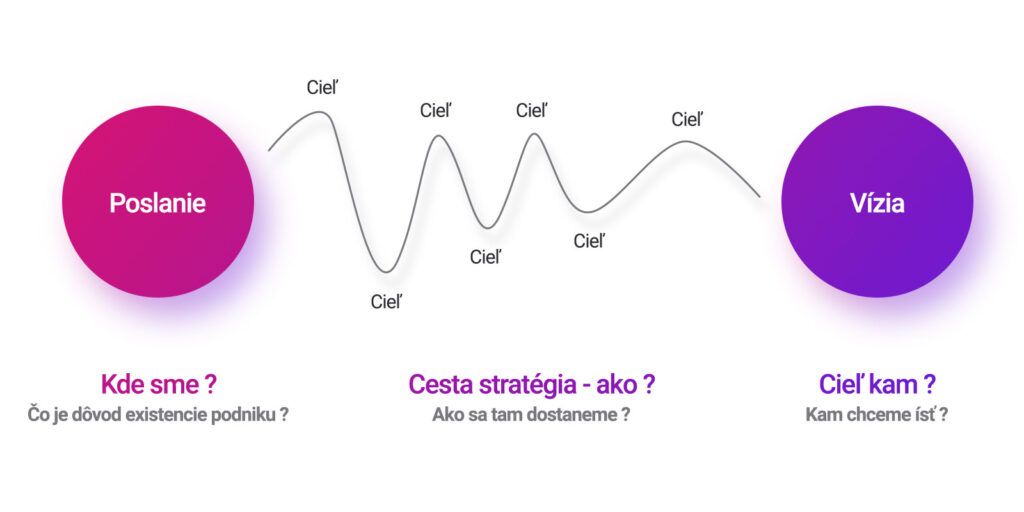
A company's mission is defined for a longer period. Its role is to describe the company's purpose and what you intend to do with it in the market. Why does your company exist and what is its significance?
A company's vision says what the company wants to achieve in the long term. Try to imagine how you would like to see your company in the future. How would you like it to look? How should it come across in the market and to your customers? Why should it stand out?
Goals (short-term, long-term)
When creating a strategy it is essential first of all to set which goals you want to achieve. Whether your goal is raising brand awareness, achieving higher revenue or reminding customers of you. Formulating goals comes out of the company's mission and vision. Different companies have different goals, which have to be defined in terms of the SMART attributes. S - specific M - measurable A - acceptable R - realistic T - time-bound
Short-term goals are goals you want to achieve in the immediate or near future. We set the time within which we want to achieve a particular goal, and also the tools needed to fulfil it. A goal may be, for instance, increasing blog traffic, setting up a Facebook page, gaining 4,000 followers in 3 months and so on.
Long-term goals are usually set for a period of 3-5 years. For instance overtaking the competition, having 5 bricks-and-mortar shops within 3 years and so on. What matters is that the goals set are realistic.
Target group
The target group is a parameter every brand should know. Your target group determines whom you will target with your advertising, your social media communication or your products. It is essential to know the target group's needs, interests and desires. If you want to do effective marketing, you cannot target everyone. Before you set about defining the target group you should do market segmentation.
Market segmentation is dividing customers into groups with shared characteristics. It involves several steps:
Researching the market and creating criteria for segmentation.
Profiling customers on the basis of the segmentation criteria into relatively homogeneous groups, determining the size of the segments and creating their profiles.
Choosing the target segment you will focus on.
The segmentation criteria, which also matter when determining the target group, are geographic, where we divide customers by where they live. Demographic, focused on dividing by age, gender, ethnicity, religion or marital status. Socioeconomic, where we divide customers by economic status, education, occupation and income. Psychological, focused on dividing by psychological profile, such as life interests, attitudes and values. The last criterion is buying behaviour, where we divide customers by the frequency and scale of purchases, loyalty and so on.
Marketing personas
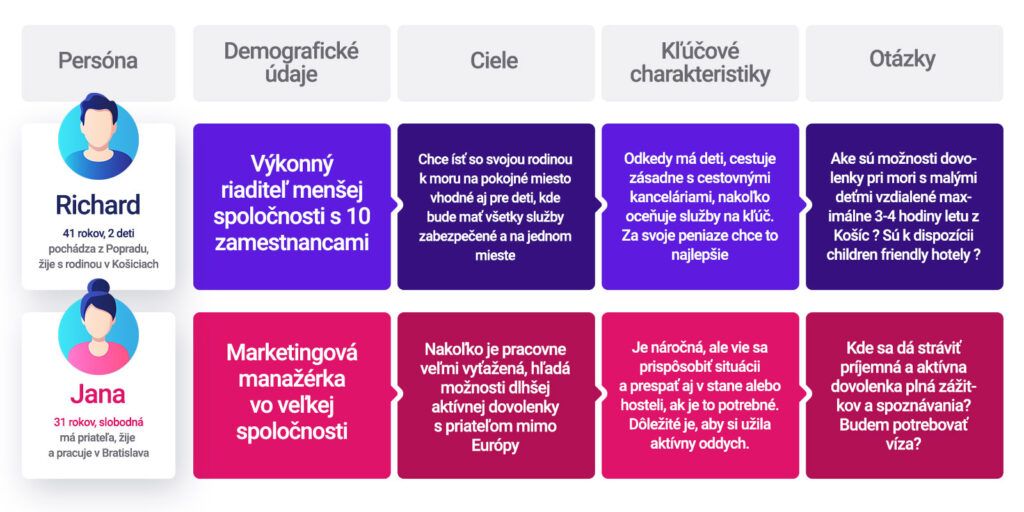
Having gained enough information about your target group, your customers' behaviour and their needs, you can move on to creating fictional marketing personas. This is a picture of a model customer. Creating personas consists of these parts:
name and photograph,
a description of their role and what their work involves,
demographic data,
what their problems and desires are that you can solve,
technical skills,
character description and leisure activities,
professional qualities,
buying habits,
the persona's questions and opinions concerning your brand, product or company.
In the marketing world there is also the term anti-persona. It is a model picture of a customer you specifically do not target, but your product may reach them by some route.
Competitive advantage
Competitive advantage is the added value you can offer your customers. A set of factors that give the customer a reason to buy from you repeatedly. With an e-shop it may be excellent advice, a gift with every purchase, a discount on the next purchase, loyalty points… Anything that sets you apart from the competition. If you know your competitive advantages, do not be afraid to communicate them on your social media and so remind your customers of them.
Choosing communication channels
On the basis of the target group and the attributes mentioned above it matters to weigh up which types of communication channel you will use to reach the goals you set. Google advertising is probably the most widespread, and you should not even have to weigh up being there. It should go without saying. The remaining channels depend on the target groups mentioned. The most widespread is Facebook, Instagram and YouTube, but for some also TikTok or LinkedIn.
Tone of voice
This is the way a given brand or company communicates with customers. Whether it addresses them formally or informally. This form of communication may differ depending on the communication channel chosen. On LinkedIn, for instance, you may use a formal register while on Instagram an informal one. This point also takes into account whether you will use humour in your communication or, conversely, serious professional communication.
This point may seem to you the last and least essential, but that is a mistake. With tone of voice you can set yourself apart from your competition and so attract new customers. It includes the colour of the visuals, by which people will know you, the sound in an ad, which matters if people are not looking at the ad at that moment but will know from the sound alone which brand or product it is. Then the typeface, and even the fact that your copy will always be in verse, for instance. There can be a great deal of it. Above all do not neglect it, be precise in choosing and start from all the available data you have.
See, Think, Do, Care?
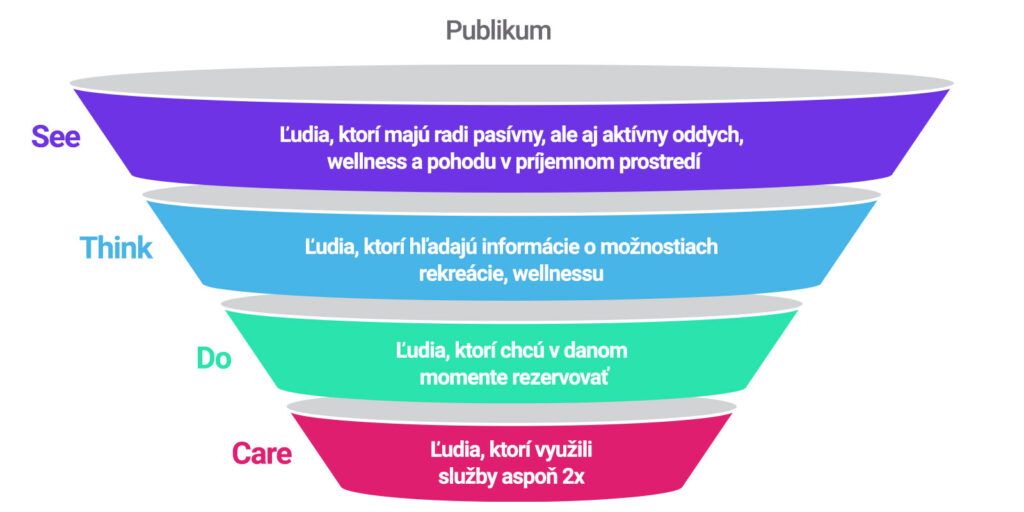
Let us look at the STDC model, probably the best known in the marketers' world. It is a marketing strategy pattern representing the buying phases a customer goes through. In the online world, though, it is not only the sale that matters but what happened before it and what will follow it. Let us go straight to the buying phases.
See
In this buying phase your prospective customers do not yet know you. That is why it matters to our team too that we bring the brand to the awareness of the widest possible group of people. That we engage and capture attention so that someone who did not know us until now learns about a new option in the market and remembers us.
Think
If you have engaged the audience enough, you are in the phase where prospective customers start to think more about us and take an interest in your products. In this phase precisely they start comparing you with the competition, whether in terms of product quality, price, the benefits you can offer them and so on.
Do
In this phase the customer has decided to buy. In this phase the aim is to ease their buying journey and help them to the final phase of buying a product or service. A well-arranged e-shop with good online advice can help.
Care
You may ask what else there is once you have achieved awareness and memorability and people are genuinely buying products and services from you… The Care phase is about building relationships with your customers, about looking after customers who have already bought from you. That is precisely what will help you keep customers and raise the rate of repeat purchases. You have won outright when the advertising that works best for you is the reviews of satisfied customers, when they post a photo with your product or a nicely wrapped parcel with a dedication and thanks from you.
Not every company goes through every STDC phase during the buying process. A company making products people buy only once in their lives, for instance, does not need to go through the Care phase, because the same customer is not expected to buy from them again. So it will focus on a new customer, with whom it will use the see, think and do phases.
How to go about creating a marketing strategy?
With us at Invelity, our strategist Libor Toporcer will take care of proposing a marketing strategy and the analysis. It works so that we use the See Think Do Care model already mentioned to find out whom you are reaching in the individual buying phases — that is, who your audience is in the See phase, who in the Think phase, who in the Do phase and who in the Care phase. It sounds simple, but it is an essential part of creating a marketing strategy that should not be neglected. At Invelity we have also created an in-depth brief that serves to identify the client, their needs and problems. It also includes a part for defining the target group and putting together marketing personas.
So what have we found?
If you have got this far, we believe you have understood what it is all really about. That it genuinely matters to have a marketing plan and to go into depth with it. Because the more you know about yourself, your product, your competition and your customers, the closer you are to reaching your goals.
Our strategist Libor Toporcer told us more: "Doing online marketing without a strategy is like setting out on a long journey by car without watching the map, the fuel level, Waze, traffic reports, your car's condition or other circumstances. Yes, you will get there in the end, but the question is how effective it will be. It is the same with online marketing. Thinking strategically means being at least a step ahead of your competition. Today it is no longer enough merely to be online — you have to do online activity effectively, deliberately and thoughtfully, and that is not possible without a precise strategy."
A marketing strategy is something that takes not only knowledge but also experience. At Invelity we have it, and we are duly proud of every piece of it. If you are looking for someone to help you create a strategy, write to us. We are certain that together we will create a marketing plan that not only you but we too will be proud of.