You invest in advertising, watch reach, clicks and video views rise… but sales stay the same? You are not alone. Plenty of firms rely, when evaluating campaigns' success, on figures that look good in reports but bring no real business result. Reach, clicks and impressions matter for building brand awareness, but if your aim is revenue, you have to track conversions.
In this article we will look at why conversion campaigns should be the foundation of every effective marketing strategy. We will show you which ad formats genuinely work, how to optimise campaigns for performance properly, and we will add a specific example from practice illustrating how you can get the most even out of an ordinary budget – if you know what you are doing and who for.
What conversion campaigns are and why you need them
Conversion campaigns represent a type of online advertising deliberately aimed at achieving a particular user action with a direct business benefit. Unlike campaigns aimed at reach, whose goal is to reach as many people as possible, or campaigns for gaining clicks, which track site traffic, conversion campaigns focus on a measurable result. A conversion is an action you want a visitor to carry out. This action contributes directly to your business goal. That can be a sale, gaining a contact or another interaction that can be used further in the sales process. It is the point where a visitor becomes a prospective customer or a real buyer.
Among the most frequent forms of conversion online are:
Filling in a contact or order form, for instance when requesting a quote or booking a consultation.
A direct purchase in an e-shop, where the user completes an order.
Subscribing to a newsletter, which opens the door to further communication.
Downloading a PDF document, e-book or catalogue, which signals interest in the content.
Clicking an email address or phone number, whereby the user decides to contact the firm.
Adding a product to the basket, which indicates serious buying interest.
Booking a service, for instance an appointment at the hairdresser, a consultation or a training course.
Interaction with a marked CTA (call to action), for instance clicking the "Get a discount" or "Start a trial" button.
Conversion campaigns are therefore not about how many people see your ad but about how many of them genuinely do what you want them to. Thanks to that they are a much better tool for maximising the return on investment in advertising. If you want your marketing activities to bring real results, conversion campaigns should be their foundation.
Why invest in conversion campaigns
Investing in conversion campaigns is worth it for everyone who does not want merely "to be seen" but wants to genuinely earn from advertising. Conversion campaigns are not just about nice figures in the statistics – they are about specific actions that move a business forward.
Better campaign optimisation
One of conversion campaigns' greatest advantages is the option of optimising them exactly for what you expect from the user. You can optimise for a purchase, a registration, filling in a form, booking a service and so on. That means the advertising system (e.g. Meta Ads, Google Ads) "learns" who to show ads to and how, so as to raise the likelihood of the result you want. You thus gain a more relevant audience and a higher likelihood of success.
A higher return on investment (ROI)
Focusing on conversions automatically means a more meaningful use of budget. Since the campaign's aim is specific performance rather than mere visibility, the investment comes back to you more effectively. You track not only how much you spent but above all how much you earned from the advertising. Thanks to thorough conversion measurement you can evaluate exactly which campaign or creative brings the best result.
Using the advertising budget effectively
You have only one budget, so it has to be spent wisely! Conversion campaigns let you direct the money where it has the greatest effect. Pointless costs on ineffective formats, target groups or messages that do not bring the result you want fall. Thanks to that you can get more out of the same budget and keep advertising performance at a higher level over the long term. Investing in conversion campaigns is a strategy that changes the way you see advertising.
Conversion campaign formats. When it is suitable to use video or a banner
Choosing the right ad format has a fundamental effect on whether your message reaches the target customer. In online marketing today two main formats dominate: video and banners. Each has its specifics, advantages and most suitable use depending on the campaign's aim.
Video content – when you need to catch attention and explain
Video is among the most effective forms of advertising in the digital space. Social media algorithms automatically favour it and users give it more attention than static content. If you need to catch attention, arouse interest and at the same time explain why your product or service is useful, video is the ideal choice.
Video is excellently suited above all to:
Products or services that require explanation – for instance software, complex solutions or new technologies.
Building a brand and trust – through authentic content, a human approach or customers' stories.
Showing a benefit or the solution to a particular problem – vividly and emotionally.
Remarketing – that is, reminding people who have already visited your site or interacted with content, in a dynamic, engaging form.
A banner – when you want to convey a message fast
Static or animated banners are an excellent tool in cases where you need to communicate a particular offer quickly, concisely and effectively. They work best with discounts, sales or simple products, where it matters to deliver the message at first sight.
Banners are ideal:
For fast scrolling, where they catch attention in the very first seconds.
For impulse sales, where the customer's fast action decides.
For reminding people of an offer – above all users who already know you and need no further explanation.
The right choice of format depends on the campaign's aim, the message you want to communicate and the stage of the buying decision your customer is at. Combining videos and banners often brings the best results. While video arouses interest and builds trust, a banner can quickly turn a decision into an action.
The most frequent mistakes that lower conversion campaigns' effectiveness
Even campaigns that have got off to a good start can lose their potential if, in planning or carrying them out, you make mistakes that hold their performance back. Here are the most frequent missteps we see with conversion campaigns, which can cost you not only money but lost customers too.
Wrong targeting or an unsuitable format
One of the most fundamental mistakes is when an ad reaches the wrong people, or a format is used that does not match the campaign's aim. For instance a video meant to catch attention is used where fast action is needed. Such as a discount or a time-limited offer. Or conversely, banners are used where it would be suitable to explain a product or build trust. If you do not align the aim, the format and the target group, the campaign will not work optimally.
Campaigns aimed only at clicks without an emphasis on the result
Tracking only the number of clicks can be misleading. A click is not a conversion. It often happens that campaigns optimised only for clicks do bring traffic but no purchases. If a campaign lacks a clear conversion goal, you will not know what is actually earning you money.
The absence of conversion measurement
If you do not implement tools for measuring conversions (e.g. the Meta pixel, Google Tag Manager, conversion events), you will not have the data on the basis of which optimisation is possible. That leads to spending budget ineffectively and losing control over the campaign's performance.
Ignoring remarketing
Remarketing is a powerful tool reaching users who have already come into contact with your brand. Many firms, though, either do not use remarketing at all or set it up wrongly. The result is that a prospective customer who had almost decided goes to the competition.
No testing and optimising of visuals
Assuming the first creative proposal will work best is a mistake. A/B testing of visuals, headlines and formats is essential for improving results. Often a small change in the graphics or the CTA can make a big difference to conversions.
Creative without a call to action (CTA)
If an ad contains no clear call to action. For instance "Book a consultation", "Get a discount now" or "Download free". The user simply does not know what to do next. Equally ineffective are universal visuals that are not adapted to the campaign's aim. For instance using brand creative in a sales campaign.
Avoiding these mistakes means your campaign will be not only visually attractive but above all high-performing and profitable. In conversion campaigns the details decide, and those have to be constantly tested, evaluated and adapted.
A real example of a conversion campaign
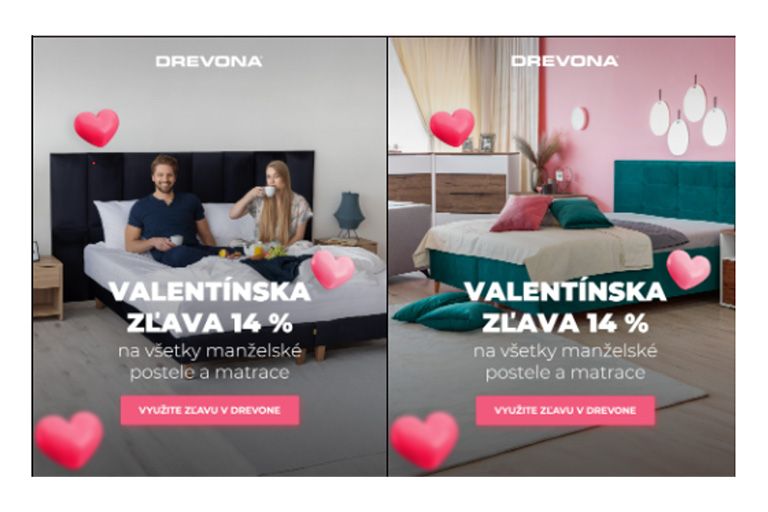
One of the most striking proofs of a properly set-up conversion campaign's effectiveness is a practical A/B test we ran for a client in furniture sales. The aim was to find out how an ad's visual treatment affects customers' decision-making and their willingness to act – that is, to buy.
The creative variants tested
In the campaign we compared two types of visual:
Graphics with people – the product was shown in a natural home setting, with people in shot. This approach was meant to evoke emotion, trust and an idea of the product's real use.
Product graphics without people – the classic "catalogue" version of the ad, where only the furniture itself was shown on a neutral background, without any context or human interaction.
The test's results
The differences in users' behaviour were marked:
150% more purchases were recorded by the version with people compared with the purely product graphics. The emotional connection and the idea of using the product in a real setting markedly raised the motivation to buy.
The click-through rate (CTR) with the graphics featuring people reached 1.48%, while the product version only 1.11%. That is a rise of 33%, which means markedly more people reacted to the ad.
The cost per conversion was lower with the human creative, which confirmed that not only quality but visual style too has a direct impact on a campaign's effectiveness.
The conclusion from the test
This example clearly shows that a campaign's visual is not merely an aesthetic matter – it is a key factor affecting the business result. An ad with people in a setting close to the target group raises trust, supports emotion and makes a product "more real".
That is why, when creating conversion campaigns, it is essential to test various creative styles so as to find out what works on your particular customers. The right visual can decide whether a campaign earns… or not.
How do we set up conversion campaigns that bring results?
If you want your advertising to genuinely earn, launching it is not enough. A conversion campaign has to be strategically planned, technically set up properly and optimised as it goes. In our practice we therefore take care of the whole process. From defining goals to optimising according to real data. Here is the procedure by which we ensure every euro invested in advertising makes sense and brings results.
1. We define what a conversion means for you
Every business has a different goal. For one it is about selling a product, for another about gaining a contact, booking a service or filling in a form. The first step is therefore always defining what specifically we want to achieve from the user. We set clear, measurable goals that we will track in the campaign. Only that way can we evaluate whether the campaign genuinely works.
2. We ensure the technical setup of measurement
Without quality data it is not possible to make decisions. That is why we make sure everything is set up properly technically. That means measurement pixels, conversion events, tracking through Google Tag Manager or Meta Events Manager. Only that way do we gain an accurate overview of what works, what does not and why.
3. We choose the right formats for the right aim
Not every ad works the same for every aim. We choose the format that best supports conversion. Whether that is video, a banner, a carousel, a dynamic ad or a lead form. Every format has its place in a campaign and its choice must reflect the aim, the target group and the stage of the buying decision.
4. We test and optimise as we go
Launching a campaign is not enough – that is where the work begins. We track results in real time, test various versions of visuals, copy, audiences and CTAs. Every detail can affect the conversion rate. We optimise the settings so that you get the most out of every euro invested.
Thanks to this comprehensive approach your advertising is not merely "present online" but actively works towards achieving your business goals. A tailor-made conversion strategy gives you the certainty that your marketing investment is considered, measurable and above all profitable.
Form, content and aim decide conversion campaigns' success
In digital marketing a simple truth applies. If you do not know what exactly you want to achieve, you will achieve nothing. Advertising without a clear aim, considered content and a suitably chosen format is like throwing money out of the window. It can look good, it can catch attention, but if it is not connected with a specific result, it will not work effectively. A successful conversion campaign does not arise by accident. It is the result of thorough planning and a strategic approach. You need:
The right format matching the aim (e.g. video for building trust, a banner for a fast sale),
Creative that communicates a clear, relevant message and at the same time catches the target group's attention
Accurate targeting ensuring the ad reaches the right people
Continuous optimisation improving performance on the basis of real data
Without this synergy your campaign will be just another item in the budget rather than an investment that genuinely comes back.
If you feel your advertising is not working to the full, sales are stagnating, or you simply are not sure how to set the strategy up effectively, turn to us. Together with you we will analyse your needs, define goals and create a tailor-made conversion strategy.
Recommended reading
The latest trends, proven practices and analyses from the digital world. Find out how to take your technology and marketing growth further.