You may know a data product feed as a product data feed, and terms such as product feeds or shopping feeds are also in use. Essentially it is only the transfer of product data from one place to another. In this article we will go through what exactly that means and why you too need one for your e-commerce business.
Did you try to understand the definition of a data product feed in the introduction but are still confused? We will explain it once more, and more simply this time.
A data product feed is a data file with information about products that you can request from the person managing your site. You can then use this file in advertising.
These are files in CSV, TXT or XML format containing information about a product. They are used by product marketing channels such as Amazon, Google and Facebook to obtain data about merchants' products for the purpose of showing product listings.
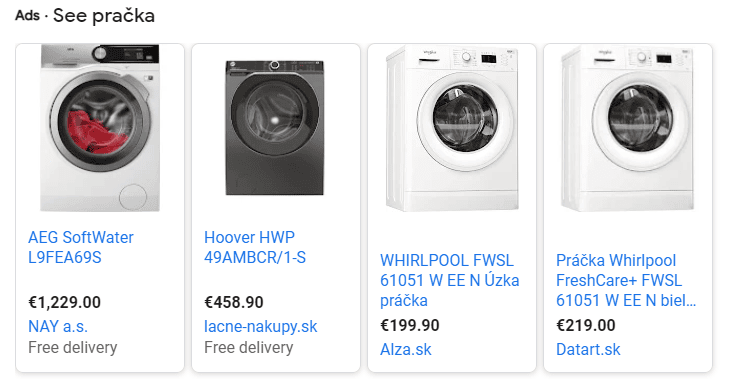
From the customer's point of view: if I look at a washing machine somewhere online, images with similar types of washing machine to the one I was choosing start appearing everywhere.
For instance:
What is the product feed's route from the website into Google Ads?
For our part we certainly recommend generating the data file / product feed in XML format, hosting it on the site and updating it regularly. You can then upload this file into the advertising systems through just 1 link placed on the site. This link should be updated regularly so that advertising campaigns always show the latest product information.
For Google Ads advertising we manage product feeds in the Merchant Center system. This system is free and needs to be connected with your Google Ads account. Ideally the product feeds are in the correct form and contain everything required by the documentation, which is freely available and which your site administrator should handle with ease (at least our IT people have no trouble with it) :)
If a product feed needs several adjustments or some structuring, adding descriptions or categorisation, we make those adjustments in Mergado. It is an excellent tool, but when we use it needlessly our monthly costs go up.
Through Merchant Center the information from the product feed travels into Google Ads, and here it is ready to be "served" to internet users through various campaign types.
What is the product feed's route from the website into Meta Ads?
Very much like Google advertising, except the product feed created is uploaded directly into the product catalogue in Meta Business Manager. It likewise needs to meet the requirements in the documentation. If it is not in the required format, we can likewise make some adjustments in Mergado.
Why is a product feed so important for e-commerce marketers?
The market share of feed-based ad formats for e-commerce advertisers in Google's services is rising.
Your online shop holds plenty of product information you can use to improve and refine your advertising campaigns. And not only that - you can add information from a huge number of sources and so create product feeds rich in data.
Most advertising campaigns use e-commerce product feeds essentially only to obtain product data. And that is entirely fine - technically there is nothing wrong with sending basic (unoptimised) product data this way.
But your product feeds mean far more. You see, shopping channels and marketplaces use your product data as an indicator of your campaign's quality. Some channels look at the data in your feed to draw conclusions about whether or not to show your product for a particular search query.
Your product feed can influence the success... or the failure of your e-commerce campaigns. Strong sellers use that to their advantage.
An optimised product feed has many advantages. Here are a few of them:
A better quality score
When deciding which offers to show customers, advertising systems have only one thing available: your product data.
What is included in your product feed is of fundamental importance. Better, more accurate product data always wins.
Data accuracy
Do your product listings match the shop's data? Is your stock up to date? Are all product updates current? Hopefully yes.
Old, inaccurate data in product listings needlessly creates chaos in campaigns. Not only is it a bad experience for shoppers, it may also cost you exclusion from some advertising channels.
Higher campaign performance
Product titles are one of the most important factors that can affect your shopping campaigns' performance - and they are an important part of your feed. When looking for the right goods a customer will scan the results pages, and the title is one of the first things they will see when they come across your ad.
It is at this critical point that a person decides whether to click and learn more. Those few words are your chance to stop them in their tracks and persuade them not to go further. You do not want needless clicks, after all! If you want the customer to be as qualified as possible before they click your ad, it matters to highlight the most important information straight away. Your product title gives you that chance. That way you also prevent shoppers being disappointed or frustrated after clicking.
Make sure your titles are distinctive enough. If they are not, it may affect your visibility. Adapt them with important, distinguishing attributes such as size, colour or gender and so describe and set apart individual products more precisely.
Price competitiveness
Price competitiveness is an important ranking factor for the Google Shopping algorithm and for many other publishers. That is because shopping ads show the price and therefore affect the click-through rate.
Price competitiveness also has a significant effect on the conversion rate. Tracking competitors' prices in Google Shopping results makes sure retail advertisers can follow their competitors' strategic price moves across the whole SKU portfolio. Once this data is added to the product feed you can use it to adjust strategies on the basis of individual products' price competitiveness.
Performance data
Adding performance data to the feed lets you group products on the basis of their marketing performance. This data also lets you optimise your campaign structure. You can automatically separate individual products into their own product groups when they reach certain volume thresholds, and you can split products automatically to separate out the best-performing SKUs.
A data product feed is a key tool for successful advertising campaigns. These files containing product information let marketers target prospective customers precisely and make sure ads are shown with current, relevant product information. Devote enough attention to managing and optimising product feeds and use their maximum potential in the competitive e-commerce environment.
Recommended reading
The latest trends, proven practices and analyses from the digital world. Find out how to take your technology and marketing growth further.