One good, effective example is driving to Croatia. That is, a comprehensive travel guide in the form of an article on the SME portal, whose subject naturally comes round again at the start of every summer.

The article covers current prices in Croatia, the shortest route, tolls and other important details. Simply everything a person looks for when they type "driving to Croatia".
The original article was published back in 2017, but thanks to regular updating it holds on to high organic traffic. The benefit of reviving content is easy to see when we examine one particular article.
Its importance stands out more still, though, when we examine a whole site. The average site constantly loses traffic from older posts and gains traffic from new ones.
The trend is a closed cycle — new content soon becomes old and organic traffic falls. New content is produced to head off the decline of the blog as a whole. Above all, though, this cycle is very expensive and inefficient.
The chart shows how the traffic you worked for "spikes". Every new piece raises it for a short period. And then it "sinks into oblivion" once more.

Where content is refreshed, the traffic reaching your site is stable. The content then produces a passive flow of visitors. Its benefit is not a one-off.

Reviving old content reduces the decline in traffic. It is cheaper than producing new content. What follows from that?
- It is cheaper to revive existing content than to keep producing new content.
- Traffic decay cannot be eliminated entirely. Regular content updates can halt the process.
Why content loses organic traffic, or how to choose a strategy for reviving old content
If you want to fix something, you first have to find the cause. With a loss of organic traffic there are several causes at once.
Increased competition
The space of the internet keeps developing, and with it the competition for individual keywords. Add to that the massive investment large companies put into content marketing. The era of easy traffic from producing content is definitively behind us. To win traffic on a subject today you have to prepare it better than your competition, build strong backlinks and promote it. And often even that is not enough.
So if you notice a gradual decline in organic traffic, try looking at the competition first. Track your important keywords in a tool such as Ahrefs, Moz or Marketing Miner. This is the simplest way to notice changes and be able to respond quickly.

Here you can see data from Ahrefs, including the drop in positions for keywords.
Small changes in your positions can have an enormous effect.
A fall from #1 to #2 can cause a 50% drop in traffic.
Freshness
The freshness of your content rests on several basic, measurable principles:
-For some queries Google favours regularly updated pages.
-Google favours regularly published new content.
-"Query deserves freshness" terms are ones where new content is favoured based on search intent, queries such as "best holiday destinations 2018" or "new Ariana Grande album".
-Backlinks disappear over time. Even if you did quality link building, your backlink portfolio loses strength eventually. So it is important to keep an eye on backlinks and to know why you lost them. Again, your content may have aged and no longer suited those linking to it. If you notice a lost backlink you can update the content and reverse that loss.
Other reasons
There are several further variables that affect decay:
Content quality: Your competition simply produces content that is better.
Technical reasons: Page speed, site structure, indexing, readability, responsiveness and a heap of other technical problems.
Search results updates: Google constantly experiments with search results and has long been working to have as many visitors as possible get their answer in the Google results themselves. Many sites can be hit by Google algorithm changes, which bring large shifts in site positions over a short period. To follow current changes to the Google algorithm you can track them chronologically, for instance on Moz.
How to revive content
At the start it takes a little detective work to find the content that needs reviving. Refresh any content that:
-had significant organic traffic some time ago
-has been falling in organic traffic for three months running or more
-accounts for at least 1% of your site's total organic traffic
It might look like this:
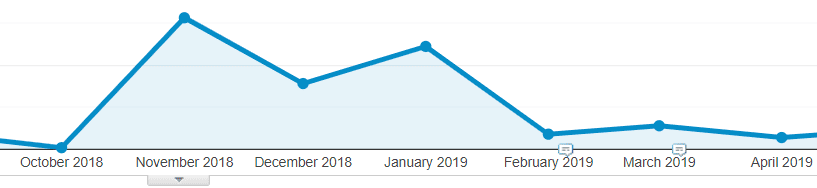
Content may call for one of the following approaches, or more than one. Choose your approach according to the reason for the drop in traffic.
Expand
This is the most common way of updating a post. Make the content richer, longer or more comprehensive. There are plenty of case studies arguing that content has to be longer to rank highly.
But the truth does not lie in length as such; you can have an article of 10,000 words that is no better for it. Length and expansion should be seen as providing greater value to the user: use examples, cite statistics and any information that can help users. That way you expand the article and open the path to a new flow of traffic.
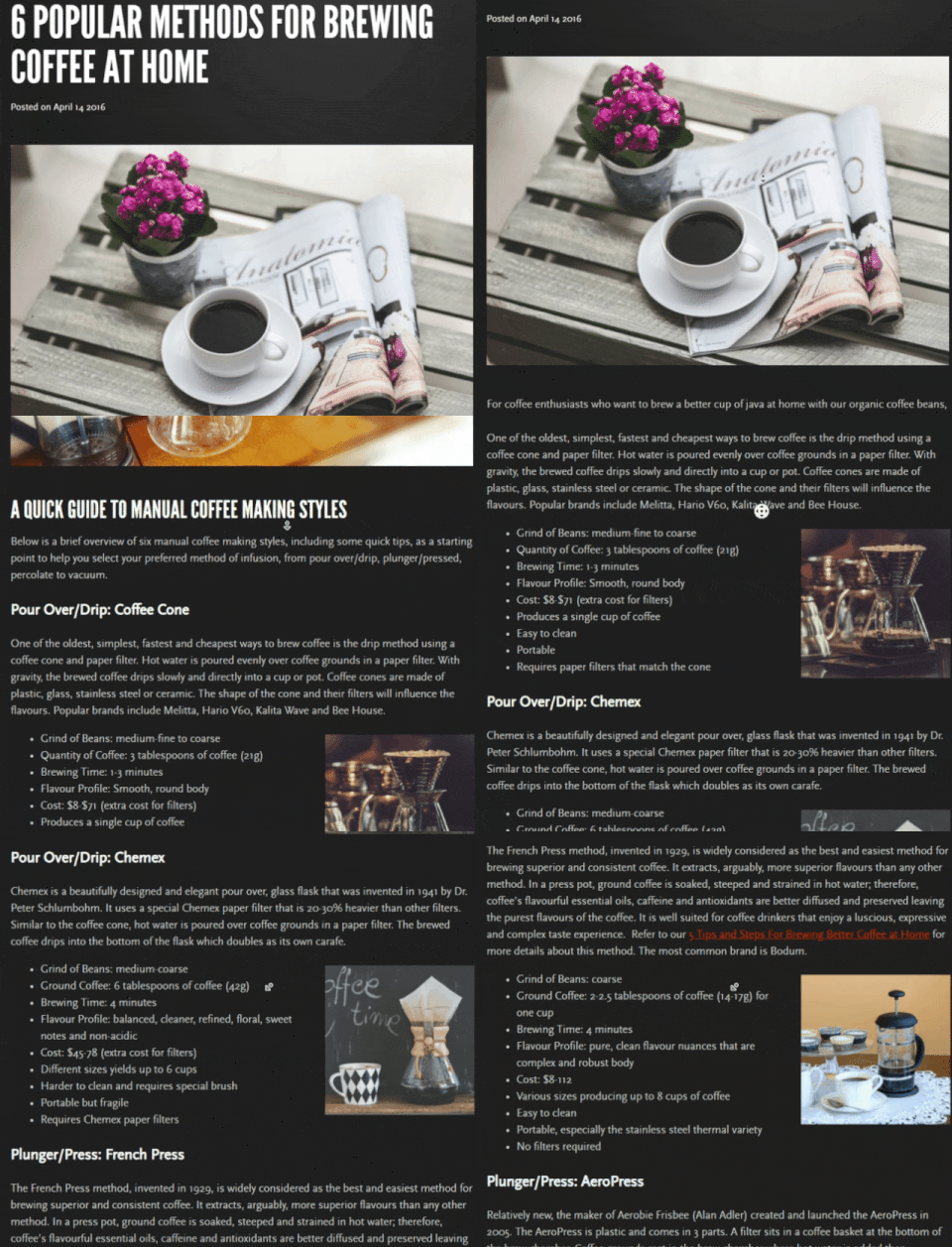
Instead of length and volume of text, focus on covering the subject comprehensively. Exactly as in the SME driving-to-Croatia example above. They covered the subject thoroughly and from several angles.
Your competition can help with ideas for expanding content. Search for your article's keyword. Look at the first results, scan the competition's content and take inspiration.
An example: imagine you are writing an article on "how to make coffee". I search the keyword and look through my competitors' pages. I note which benefits they emphasise, what article format they use, from what angle they approach the subject.
In a competitor's article I noticed they cover various methods of making coffee (picture above). They write about the French Press, AeroPress and Chemex. They give me an overview of what type of coffee to use, how long it takes and what it costs. They cover the whole subject comprehensively. That tells me that people who search "how to make coffee" want to know the various brewing methods, their advantages and the specific differences.
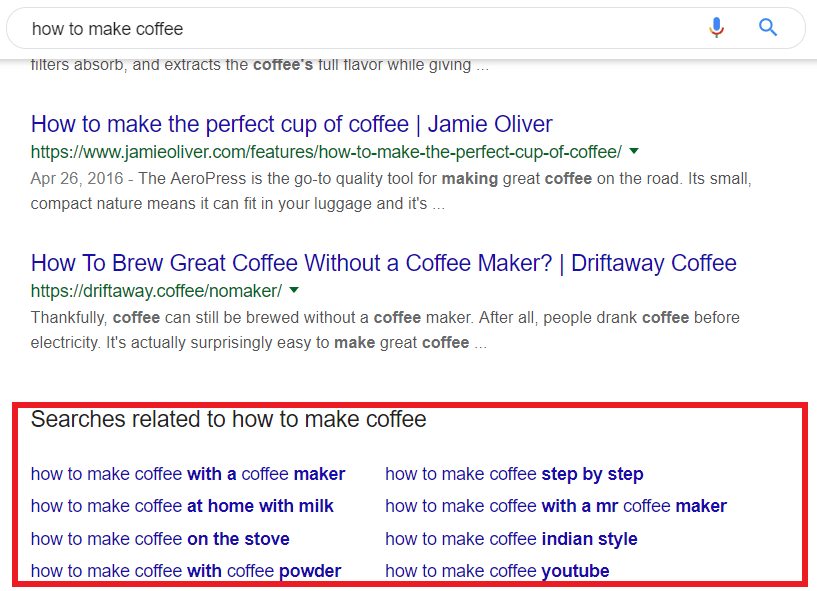
Another excellent way to work out what information I could expand the article with is related search terms, found at the bottom of the Google results page.
In this case it tells me I could write a step-by-step guide (how to make coffee step by step) or how to make coffee on the stove.
Update
Some subjects go out of date quickly. An article on "best gaming laptops 2018" has an expiry date. At other times it is less predictable. You may have to update a guide on "how to build an email form" with GDPR information, or revise an article on "autumn dressing tips" with current trends.
Prepare a list of articles that need updating, with reminders so you do not forget.
The list should include:
-Any content containing a date (insurance prices 2019)
-Any content consisting of a lot of screenshots (how to contact Instagram)
-Articles on constantly shifting subjects (Boris Kollár's partner)
Optimise
Sometimes content declines because weaker content is better optimised for the search engine. Using the following checklist you can check whether your content is sound from an SEO point of view:
-Make sure the meta title contains the keyword you want to rank for, ideally near the start
-Write a great h1 that draws the reader into the article; it can contain the keyword too
-Use keywords related to your subject — for an article on landmarks in Italy that might be the Colosseum, the Leaning Tower of Pisa and so on
-The URL should describe the article's content while staying short
-Check that technical problems with the site are not causing you trouble.
-Make sure images are properly optimised and have alt text
-Write an enticing meta description with keywords that makes full use of the length Google uses
-Break the content into paragraphs and use subheadings so it is easy to read
-Link to sources that complement your article, whether on your own site or external
Of course, this checklist simplifies the whole subject a great deal; you can copy the full checklist HERE.
For your content to succeed again, repeated promotion and link building are sometimes needed. After a few months or years you have probably produced a good deal of new content. That brings excellent opportunities for internal linking.
For instance, to build new internal links to the article an introduction to Google Tag Manager, a quick search with the site: modifier will find the opportunities on the site.
We search for where we mentioned the words Google Tag Manager and link them to the article if we have not already:
google tag manager site:invelity.com
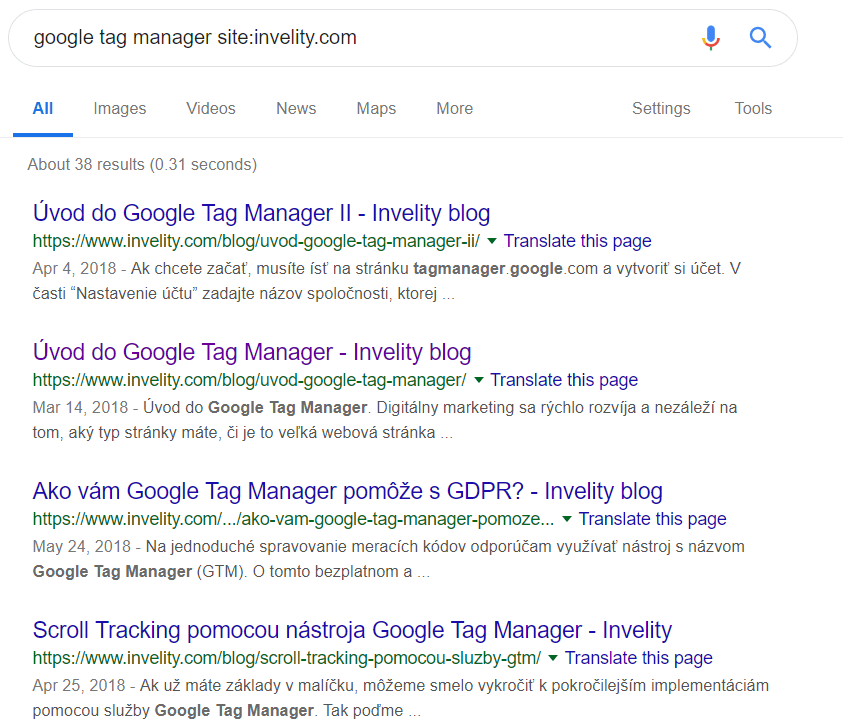
As you can see, it showed me every result containing the words "google tag manager" on site:invelity.com
The site: modifier shows you content only on the site you specify. Then you simply enter a word relevant to your content. If you can link from several sites, use OR between the individual site: terms.
Example:
The word you want to link from site: yoursite.com
Example if you have several sites:
The word you want to link from site: yoursite.com OR site: yourothersite.com
You can also send your content out through a newsletter, build external backlinks, share it on social media or pay for advertising. It works best if you have expanded, updated, optimised or merged the content.
Regular work, good pay
Remember, regularity and method are the only way your content can pay off over the long term. Make sure your editorial calendar has room for reviving old content too. Set aside a budget and time that reflect the demands of content work properly. It is worth it.
Did the article interest you, or do you need help reviving your content? Get in touch