How is AI changing the rules of the game in digital marketing?
As marketers we know the power of technology that helps us reach our audience. Whether it is using chatbots to interact with customers or creating predictive…
As marketers we know the power of technology that helps us reach our audience. Whether it is using chatbots to interact with customers or creating predictive analytics models that can identify trends in your industry. AI has a huge influence on how companies connect with their audience. But what actually is AI? And how can you use it in your business? In this article we will explore the basic concepts connected with AI.
The abbreviation AI comes from artificial intelligence, or umelá inteligencia in Slovak. Among the first to describe the term was John McCarthy (a professor at Stanford University) as early as 1955, who defined AI as the science of making intelligent machines.
Essentially it works on two principles: autonomy and adaptability.
Autonomy means a computer is able to carry out complex tasks without a third party's intervention. Here we can mention creating graphics, text or calculations, for instance.
Adaptability, on the other hand, means a computer is able to improve its performance by continuously learning from experience already gained. A typical example is chatbots on websites that help with choosing products.
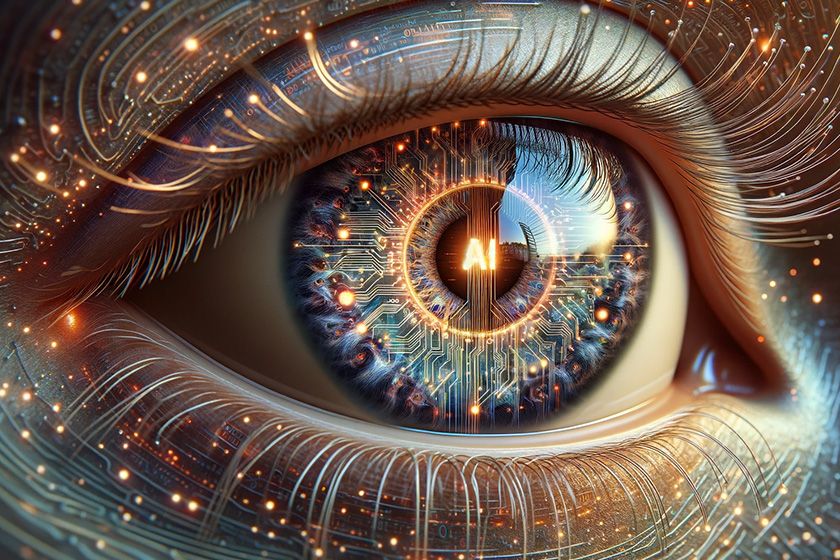
Image generated by AI ChatGPT4 DALL-E prompt: an image with a real human eye and artificial intelligence in the pupil
What the key terms mean: AI, chatbot, machine learning, deep learning
In personal life and of course in business, artificial intelligence tools offer a wide range of uses that can improve efficiency, raise productivity or open up new possibilities. Artificial intelligence will help you analyse a huge amount of customer data or with personal development. AI is machine learning, which consists in using large amounts of data, computation and algorithms to generate the desired outputs. Artificial intelligence can itself analyse a task, gather and then evaluate data, and on that basis solve the task.
Chatbot
A chatbot is an artificial intelligence tool in the form of a live chat that can communicate in human speech. It is not merely speech synthesis, though. A chatbot will answer your questions about products or services and can give tips and ways of using them effectively.
Chatbots are more than just virtual assistants – they are also used as customer support agents in businesses running online sales sites or live chat systems; their aim is to improve the customer experience by answering questions quickly without staff spending time replying by email or telephone.
Image generated by ChatGPT4 DALL-E prompt: an image for the article How AI is changing the rules of the game in digital marketing
Machine learning
Machine learning is a type of artificial intelligence. It is used for forecasting on the basis of data, which can be used to improve the user experience and search engine rankings.
Machine learning works by using algorithms to analyse large amounts of information in order to determine patterns and trends that may not have been obvious before. The result is an algorithm that can then be applied to various situations for greater accuracy or effectiveness in predicting results (and so improving future results).
Deep learning
Deep learning is a specific kind of machine learning whose creators drew inspiration from how the human brain and neural networks work. Unlike other forms of machine learning, deep learning does not even know at the start what the aim of the investigation will be. The deep learning process works so that the computer notices internal differences and creates hypotheses itself, and then confirms or refutes those hypotheses itself. Take a look at the scientific article that says more about how to use deep learning techniques.
Predictive analytics
Predictive analytics is a subset of artificial intelligence that can be used to predict future outcomes. For instance it could be used in marketing to predict customer behaviour and purchase history. Predictive analytics is also used in healthcare, finance and other industries.
Prediction is complicated given that people have a very limited ability to understand complex relationships between several variables or factors. Computers, however, have no trouble understanding these relationships, because they are built on various algorithms that let them narrow thousands or millions of possibilities to a single possible outcome at any given moment.
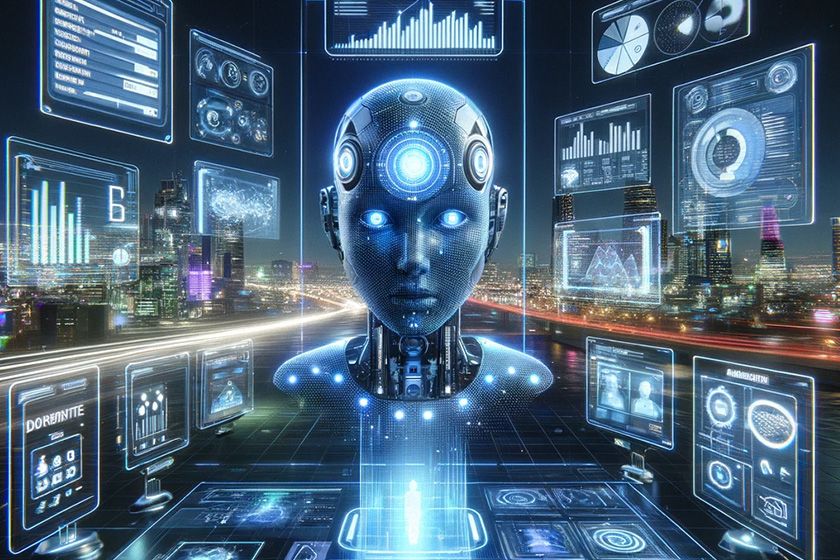
Image generated by ChatGPT4 DALL-E prompt: an image of an AI figure analysing the digital marketing environment
Automation and AI
In marketing, artificial intelligence is transforming how companies communicate with their customers, analyse large amounts of data and personalise marketing campaigns. From chatbots giving instant customer support to algorithms predicting consumer behaviour, AI opens new possibilities for marketing professionals to be more creative and more effective. Artificial intelligence and automation let you do your work better and more effectively, but they are no substitute for human intuition or intelligence. It matters to realise that although AI can automate some tasks, it also requires human oversight and creativity – the ability to think outside the box or create something new from nothing.
How to use AI to your advantage?
Using AI for personal purposes will make your everyday activity more efficient, raise your effectiveness at work, open doors to new opportunities, or plan a holiday, a date or an unusual Christmas present. Applications based on AI, as digital assistants, will help you manage your calendar or remind you of important events. In marketing, AI can help personalise customer experiences, analyse consumer behaviour and automate repetitive tasks. Education is another area where you can use the advantages of AI tools to the full. AI is currently opening doors to innovation in healthcare too, from early diagnosis of disease to personalised medicine. Investing time in learning AI tools is certainly worthwhile.
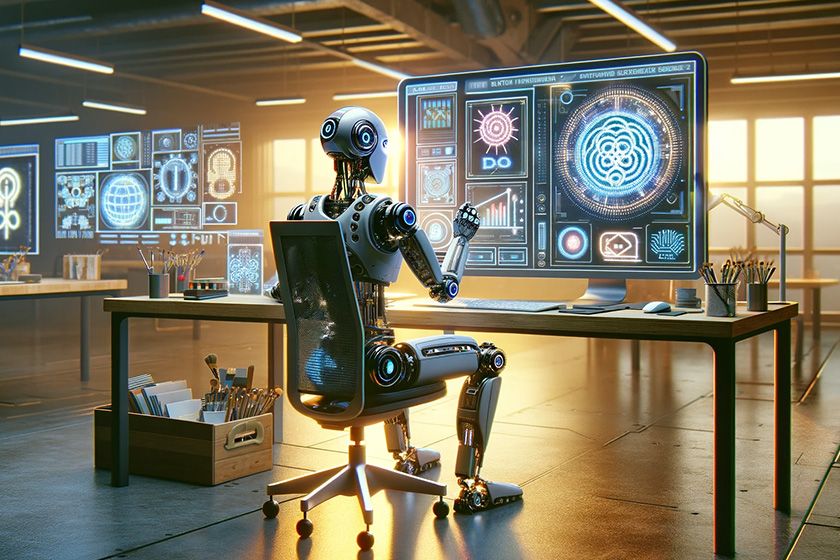
Image generated by AI ChatGPT4 DALL-E prompt: a landscape image on the theme of artificial intelligence where a robot is designing a new logo
Implementing AI into a marketing strategy
Even though AI has been used for many years in other industries such as healthcare and finance, it has only recently become a major trend in digital marketing.
Before implementing AI into your marketing strategy it matters to define your marketing goals clearly. It may be increasing conversions, improving customer service or automating repetitive tasks.
The AI tools and technologies you can use range from chatbots for improving customer support, generating images, videos and text, to machine learning algorithms for data analysis. When using AI in marketing strategies it also matters to weigh up ethical questions. Protecting customers' personal data and the transparency of algorithms are key aspects marketing professionals should not forget.
AI applications in marketing
AI lets companies collect and analyse data about customer behaviour in real time, which leads to creating personalised marketing messages. The ability to personalise not only raises customer engagement but also improves their overall experience of the brand.
Chatbots and virtual assistants can give customers instant, available support 24 hours a day, 7 days a week. Such customer support can answer common queries, solve simple problems and even carry out transactions.
One of AI's greatest advantages is its ability to process and analyse a huge amount of data faster and more accurately than a human. Marketing professionals use AI to identify trends, predict consumer behaviour or optimise marketing campaigns.
Applications using artificial intelligence will undoubtedly transform the marketing world, opening new possibilities for personalisation, work efficiency and innovation. A key aspect of success, above all for marketing professionals, will be systematic learning of the skills connected with using artificial intelligence.
Artificial intelligence is here to stay and will go on shaping the future of digital marketing. As you have read in this article, there are many ways you can use AI to improve the effectiveness of marketing campaigns. It does not matter whether you own a small business or a multinational. Catching a trend is a matter of life and death in business.
Recommended reading
The latest trends, proven practices and analyses from the digital world. Find out how to take your technology and marketing growth further.