SWOT analysis: the complete procedure + a template to download
Planning is one of the key steps in successfully running any company. Whether you are starting out or an experienced businessperson, it matters to know your company's strengths and weaknesses and…
Planning is one of the key steps in successfully running any company. Whether you are starting out or an experienced businessperson, it matters to know your company's strengths and weaknesses and to have an overview of opportunities and threats in the market. One of the most effective tools that will help you gain this overview is a SWOT analysis.
In this article we will look at how to create an effective SWOT analysis, what it should contain and how to apply its results to create a strong business strategy. You will learn why a SWOT analysis matters so much, how to make the most of it and when it may be suitable for your business.
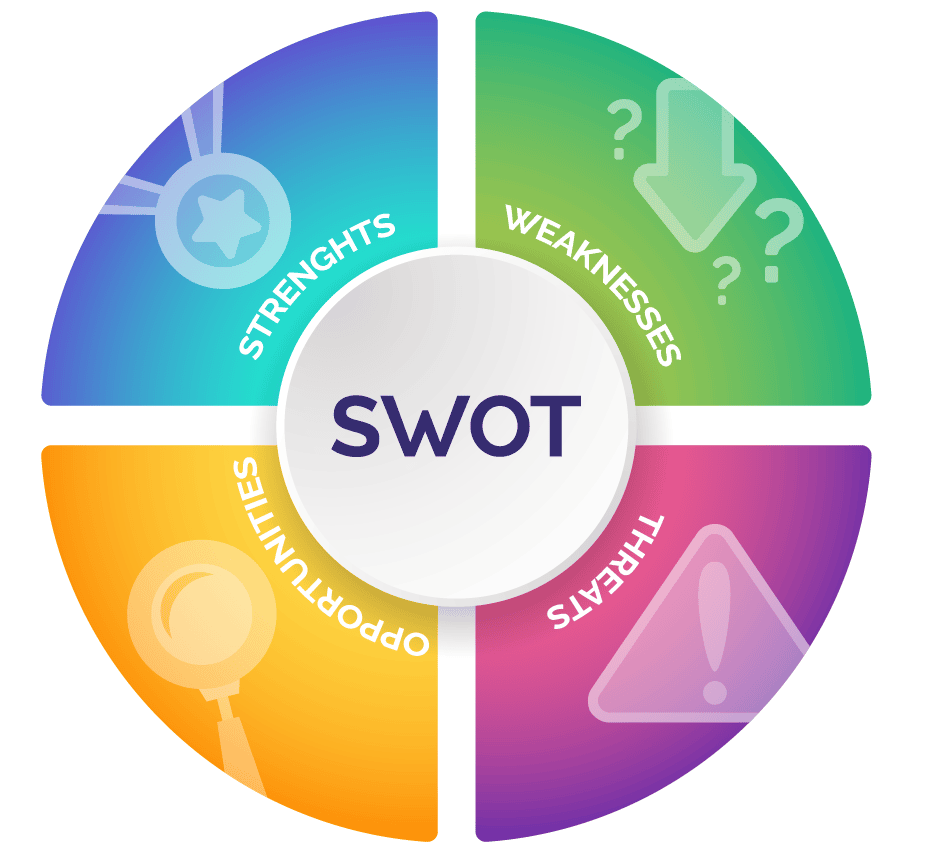
A SWOT analysis is one of the most popular tools in strategic management.
It helps identify strengths and weaknesses (the internal environment) and also opportunities and threats (the external environment). The SWOT analysis technique has been here since 1965, but it is still current.
A SWOT analysis assesses 4 key areas of a company:
Strengths: internal factors that are the company's advantages or strong points. They may be unique abilities, resources or assets that set the organisation apart from the competition.
Weaknesses: internal factors that weaken the organisation or hold it back from reaching its goals. They may be shortcomings in finances, technology, human resources or processes.
Opportunities: external factors or trends the company can use for its growth and development. They may be changes in the regulatory environment, technological innovations, new markets or customer needs.
Threats: external factors that can threaten a company's success or slow its growth. These include competition, economic swings, legislative restrictions and changes in customer behaviour.
Assessing the individual areas leads to the SWOT analysis's main aim, which is formulating a strategy. Formulating a strategy is, simply put, creating strategies.
Strengths
A "strength" is something a business is good at, or a quality of the business that gives it a significant capability. It may be a skill, resource or asset that puts the business in a position of market advantage — a better product, a stronger brand, innovative technology, better customer service. Strengths describe what an organisation excels at and what sets it apart from the competition. (Gallo, 2013)
Strengths
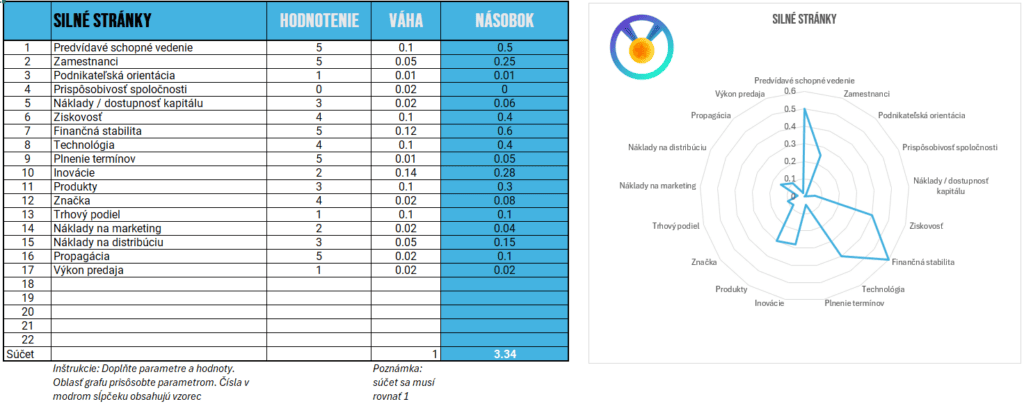
Potential strengths may be: • sufficient financial resources • a recognised market leader • properly conceived functional strategies • economies of scale • insulation from strong competitive pressure • proprietary technological approaches • a cost advantage • persuasive advertising campaigns • the ability to innovate products • very good production capabilities • excellent technological skills • and so on
Weaknesses
A "weakness" is something a business lacks, does poorly compared with others, or a condition that puts it at a disadvantage. Weaknesses hold an organisation back from reaching its optimal performance.
These are areas in which a business has to improve to stay competitive: a weak brand, higher staff turnover, high debt, an inadequate supply chain or a lack of capital. (Gallo, 2013)
Weaknesses
Potential internal weaknesses may be: • unclear strategic intentions • outdated production facilities • below-average profitability • a lack of management skills and talent • missing key capabilities • inconsistency in implementation • lagging in research and development • a weak market image • a weak distribution network • below-average marketing abilities • an inability to finance necessary strategies and strategic changes • others
Opportunities
Opportunities relate to favourable external factors that could give an organisation a competitive advantage. For instance: a market opening or an improved position for winning new customers; a rise in sales to current customers; making use of competitors' problems; gaining further sales channels, improving logistics; outsourcing less important activities; gaining key employees from the competition and so on.
Opportunities
Potential external opportunities may be: • the emergence of new consumer groups • the opening of new markets or market segments • extending product lines as a result of new needs • diversification into related products • the fall of trade barriers in attractive foreign markets • accelerating market growth • others.
Threats
Threats are factors that can potentially harm an organisation. Common threats include rising material costs, growing competition, a shortage of labour and so on.
Threats
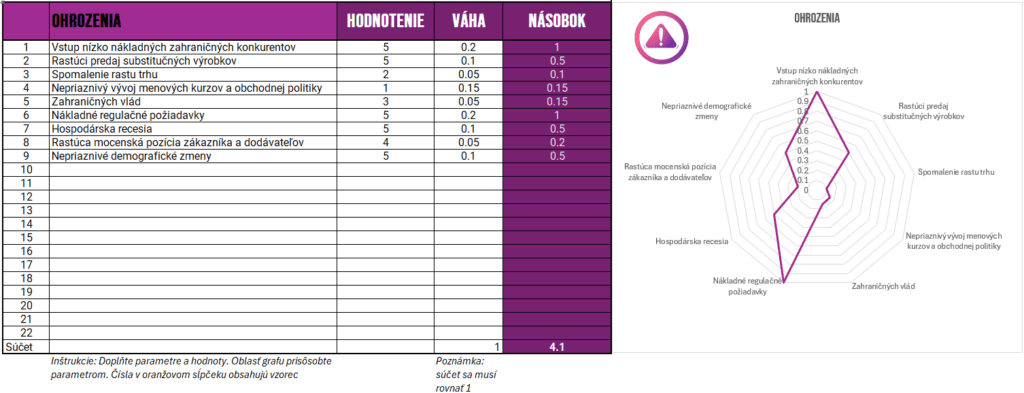
Potential external threats may be: • the entry of low-cost foreign competitors • growing sales of substitute products • slowing market growth • unfavourable movements in exchange rates and trade policy • of foreign governments • costly regulatory requirements • an economic recession • the growing power of customers and suppliers • unfavourable demographic changes • others.
Why use a SWOT analysis?
A SWOT analysis's value lies above all in the fact that, when the analyses are done properly, it helps formulate the company's strategy. Besides that it gives management the chance of self-assessment. Although putting a SWOT analysis together may seem simple at first sight, experience shows that creating it takes time and considerable resources. Determining an organisation's strengths and weaknesses, and assessing the impact and likelihood of opportunities and threats, is far more demanding than it seems at first sight.
How to do a SWOT analysis?
We could say a SWOT analysis is a comprehensive analysis, since it involves assessing the external and internal environment. To be able to fill in the 4 clusters of a SWOT analysis you need to analyse the business's internal and external environment. We have to realise that a SWOT analysis is not only about filling in 4 clusters. The better and more detailed the analyses, the more accurate the result. When working it up you can use our clear Excel template for quick calculation with tables and charts.
3. Assessing the individual parameters within the 4 clusters
4. Adding up the results
5. Determining the strategy on the basis of the results
Analysing the internal environment (identifying strengths and weaknesses)
Analysing the internal environment means identifying internal factors that affect a business's ability to meet its goals and keep a competitive advantage in the market. Internal analysis gives a detailed view of a business's strengths and weaknesses. At the same time it gives an overview of the resources, processes and capacities affecting the business's ability to respond to changes in the market environment.
Analyses needed when identifying strengths and weaknesses:
analyses of the company's resources (human resources, financial resources, tangible and intangible resources)
value chain analysis (where value is created in the business)
retrospective analysis (looking at previous results)
industry comparison (comparing with the competition - average industry indicators)
Objectivity: when assessing strengths and weaknesses it is essential to be objective. Overestimating your own abilities or underestimating weaknesses can lead to wrong decisions.
Relevant data: it matters to work with current, accurate information, because out-of-date data can skew the results and lead to mistaken conclusions.
Involving key employees: identifying strengths and weaknesses should include input from employees in various departments. Every department has a different view of the processes and internal factors that can be key to success or failure.
Comparison with the competition: when assessing strengths and weaknesses it is useful to compare with the competition. It helps you understand where the business is better or worse than others in the market.
Taking future trends into account: in the analysis it matters to take into account not only the current state but also potential future trends and challenges that can affect the business's internal environment.
An example of assessing strengths and weaknesses
Analysing the external environment (identifying opportunities and threats)
Assessing external environment factors means first of all recognising opportunities and threats, and at the same time gaining information about the current and expected development of external factors expected to affect, or that might affect, the business's activity.
If you want to analyse the external environment you need to carry out these analyses:
external environment analysis (PEST or PESTLE analysis)
competitor analysis
Porter's five forces model
What to watch out for in a SWOT analysis?
Assumptions without evidence: when assessing opportunities and threats, avoid unverified assumptions. It matters to work with verified, current information.
Overestimating opportunities and underestimating risks: managers sometimes tend to overestimate opportunities and underestimate potential threats. It matters to be realistic and take the worst scenarios into account too.
Geopolitical factors: political stability, trade barriers and global conflicts can markedly affect business, above all in international markets.
The regulatory and legal environment: changes in legislation such as new laws, tax reforms or environmental regulations can mean either new opportunities (subsidies for green technologies, for instance) or threats (stricter regulation, for instance).
Macroeconomic factors: economic recessions, inflation, interest rates, unemployment – all these factors affect customers' purchasing power and businesses' stability.
Technological innovation: new technologies can bring great opportunities but also threats for businesses unable to innovate and adapt to new trends quickly.
Market dynamics: do not forget to follow market trends and the competitive environment regularly so as to be ready to respond to fast changes.
An example of assessing opportunities and threats
Assessing the individual parameters within the 4 clusters
Having carried out the analyses of the external and internal environment, we summarise the results in a table. We rate the results on a scale of 1-5. Then we add weights, that is the importance of the individual parameters. The sum of the weights in each quadrant must equal 1. We assign weights in the range from 0.00 to 1.00, and the sum of all the items must equal 1. The more important the parameter, the higher the coefficient. We multiply and add up the values obtained in each cluster separately.
Adding up the results
We then add up the results for the internal part of the SWOT analysis (strengths and weaknesses) and the external part (opportunities and threats). A positive result signals that you can go ahead with the project, change or other activity. After subtracting the internal and external parameters.
In this case the resulting strategy is given by a combination of weaknesses and threats. The chosen strategy should involve limiting production or possibly winding up the company.
Determining a strategy on the basis of the SWOT analysis results
Having identified all four areas of the SWOT analysis, it matters to define the possible strategies.
The strategies may be:
SO strategies (Strengths + Opportunities): using the business's strengths to make the most of the opportunities identified. These strategies aim at development and expansion, entering new markets or introducing innovative products, for instance.
ST strategies (Strengths + Threats): using the business's strengths to minimise or eliminate external threats. This is a defensive strategy in which the business tries to face external threats using its strengths.
WO strategies (Weaknesses + Opportunities): strategies focused on overcoming the business's weaknesses so that it can make use of opportunities in the market. This may involve improving internal processes, training employees or investing in new technologies.
WT strategies (Weaknesses + Threats): strategies aimed at minimising the risks arising from weaknesses and threats. This may involve restructuring, cutting costs or working with other companies to overcome risks.
Combination I.
SO (Strengths-Opportunities): Strategies that use your strengths to make use of opportunities.
OFFENSIVE STRATEGIES
Combination II.
ST (Strengths-Threats): Strategies for using your strengths to eliminate or reduce threats.
DEFENSIVE STRATEGIES
Combination III.
WO (Weaknesses-Opportunities): Strategies that improve weaknesses in order to make use of opportunities.
ALLIANCE STRATEGIES
Combination IV.
WT (Weaknesses-Threats): Defensive strategies that try to minimise risks and weaknesses.
RETREAT or LIQUIDATION STRATEGIES
In summary
A SWOT analysis gives companies a unique chance to assess their current position and prepare for future challenges. It matters to note that a SWOT analysis is not a one-off exercise but a continuous process. The environment you do business in keeps changing – new technologies appear, legislation changes, the competition develops and customer preferences shift.
In short, a SWOT analysis is not merely a list of individual factors. It is astrategic process that lets you see the company from a distance. On the basis of a SWOT analysis you can make informed decisions and plan. It is a tool that makes you ask the right questions, look for deeper answers and keep improving. Thanks to a SWOT analysis you can strengthen your strengths, improve your weaknesses, make use of opportunities and head off threats, which leads to long-term growth and sustainable success in the market.
SWOT analysis and the BCG matrix without effort. Download our clear template ?
Leave us your e-mail and we'll send it straight to your inbox. You'll also start receiving practical tips from the world of digital marketing.
By entering my e-mail I consent to the processing of my personal data for the purpose of receiving Invelity's monthly newsletter. You can unsubscribe from the database at any time.
I am interested in a digital marketing strategy
Get in touch and arrange a meeting with us in Bratislava, Zvolen or even San Francisco. We will be glad to help you with your project.
Contact form
Finally, if you have not yet carried out a SWOT analysis for your organisation, now is the right time to start. Be critical, be creative and remember that the aim is to determine a strategy that will take you to the goal you want.
Recommended reading
The latest trends, proven practices and analyses from the digital world. Find out how to take your technology and marketing growth further.