
Valéria Lapínová
PPC & SEO specialist
You have surely come across the term KPI - Key Performance Indicators - in your work, or at the very least you have heard of it. Many people associate this term with some goal they want to achieve. If you want to look deeper into what KPIs mean, though, and find out how to set them, read on.
The abbreviation KPI defines a key performance indicator - a quantifiable measure of performance over a certain period for a particular goal. KPIs are an excellent help in measuring progress towards strategic goals. Many businesspeople use KPIs to assess the factors supporting their company's efforts on the road to success.

The abbreviation SMART is often associated with key performance indicators. This abbreviation represents the qualities a properly set KPI certainly should not lack:
A particular metric may have occurred to you in connection with KPIs. There are differences between them, though, that set them fundamentally apart.

You are probably asking yourself whether setting KPIs is really so important for your business. Judge their importance for yourself. To make the decision easier we have written down the basic benefits of KPIs for you:
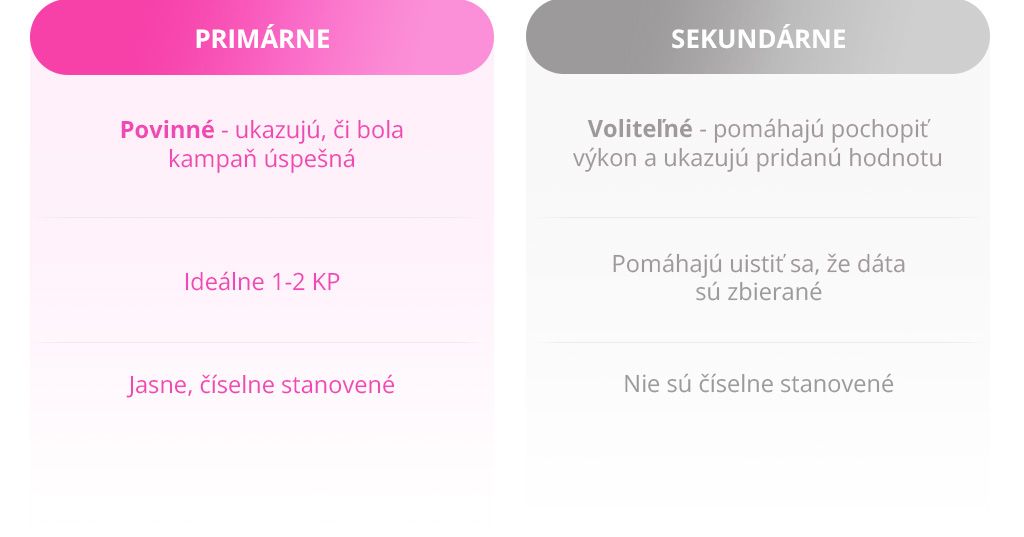
When setting KPIs we distinguish two basic groups - primary and secondary.
When setting KPIs you also need to take account of activity within the buying cycle. The buying cycle is made up of 4 basic parts:
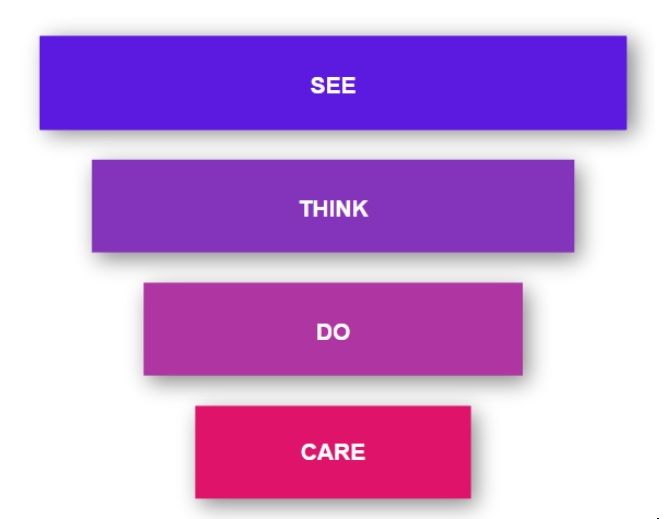
SEE - In this phase consumers do not yet know the brand or product. KPIs in this phase should be aimed above all at building brand awareness. When setting KPIs we recommend focusing on impressions, viewable impressions, frequency and brand lift.
EXAMPLE: Gain 371,000 impressions in March at a CPM of €1.40 and a budget of up to €520.
THINK - This is the consideration phase. The audience already knows the brand or product, compares it with competitors and thinks about the options. KPIs in this phase consist in supporting prospective customers' purchase intent and supporting brand search. In this phase it is suitable to orient KPIs towards engagement, on-site interactions, reading an article to the end, post-view conversions, newsletter sign-ups and click-through rate.
DO - The phase in which consumers want to carry out a particular conversion, buying for instance. In this phase customers move to a purchase. The most suitable KPIs in this case are oriented towards supporting and increasing sales. When setting KPIs we recommend focusing on cost-of-sale ratio, ROAS, CPL, conversion rate, turnover and lead count.
EXAMPLE: Increase turnover month on month by 30% at a cost-of-sale ratio of up to 25% and a budget of €1,200.
CARE - Customers have already used your product and plan to use and buy it in the future too. This is the phase of caring for a customer already won. In this phase we aim KPIs at lifetime value (an estimate of the average revenue a customer will generate across all their future purchases), the number of repeat purchases, cost-of-sale ratio and conversion rate.
The right approach to setting KPIs that are genuinely meaningful matters. If setting KPIs is hard for you, try to find answers to the following questions.
What is the goal of your measurement? Why is this goal important for the business? How much time do you need to fulfil this goal? What specifically will you measure in the company? How do you want to measure it? How often will you measure it?
When putting together a proper KPI, do not forget the basic qualities every KPI should meet:
| An example of a properly set KPI |
|---|
| Achieve at least 7,333 leads in April at a cost per lead of up to €6 and a budget of up to €44,000. |
With e-shops the most commonly used KPIs are:
| ROAS |
|---|
| The abbreviation ROAS stands for the return brought by spending on advertising credit. ROAS helps businesses evaluate which methods work and how they can improve their future advertising efforts. |
| ROI |
|---|
| Return on investment (ROI) is a performance indicator used to assess the effectiveness or profitability of an investment, or to compare the effectiveness of several different investments. |
| NEW CUSTOMER REVENUE |
|---|
| This is the revenue generated by new customers. |
The best and most suitable KPI we can set for e-shops is margin - the percentage share of the difference between the selling and the purchase price.
Whether the key indicators you set were met or not can be tracked simply and clearly in Google Analytics. In some cases, though, shortcomings and inaccuracies can arise in collecting and measuring data, which is why we recommend evaluating the results in the admin panel too.
The most common KPIs we can track with lead generation sites are above all bounce rate, conversion rate, quality and relevant leads and cost per lead.
| CONVERSION RATE |
|---|
| Raising the conversion rate also means strengthening the lead generation strategy. We can calculate the conversion rate simply as cost/number of conversions. |
| QUALITY LEADS |
|---|
| Quality leads are the most important key performance indicator to track. Assess your lead generation strategy's performance in terms of their quality. Fine-tune the marketing campaign's efforts so as to gain a more relevant perspective and so win better quality leads. |
| COST PER LEAD |
|---|
| Cost per lead is an indicator that goes hand in hand with lead quality. Among all the key performance indicators in lead collection it is the only one that will help you judge the cost-effectiveness of your lead generation efforts. |
The best KPIs we recommend measuring with leads are above all lead relevance, return on investment and offline conversions such as in-store purchases.
When evaluating whether lead KPIs were met we proceed the same way as with an e-shop. So in this case too Google Analytics is an excellent tool.
Another excellent tool that can simplify evaluating your marketing efforts is a CRM (Customer Relationship Management) system. With a CRM system you can automate and integrate data about customers and the activities aimed at them, such as sales, marketing, service and e-commerce.
With brand campaigns we focus on supporting the brand and building awareness of the brand or products. In this case the most commonly used KPIs are unique users, CTR and impressions.
| UNIQUE USERS |
|---|
| These are individual users of a website over a given period. This metric records a user regardless of how many visits they made or whether they were on the website for the first time. Every time a user visits a website their IP address assigns them a unique identifier, which Google Analytics can then track to record the number of visits to the site, page views and other user behaviour. |
| REACH |
|---|
| Reach is the number of unique users who saw your activity. It can take various forms; generally there are three: organic reach, paid reach and viral reach. These different types of "reach" correspond to the way the content was presented to the internet user. Organic reach corresponds to all the people who saw your page without it being promoted. It is your natural reach, which tends to fall over time. Paid reach is the number of impressions resulting from promotions you set up to increase your visibility and reach more people. Viral reach is the number of visitors who saw your content as a result of interaction and sharing by other users. |
| CTR (click through rate) |
|---|
| Click-through rate shows the ratio of impressions to clicks. We calculate it as clicks/impressions. |
| IMPRESSIONS |
|---|
| If you are planning a brand awareness campaign, its success will depend above all on the number of ad impressions. |
| FREQUENCY |
|---|
| Ad frequency shows how often your ad is shown to a unique user. Ad frequency represents how many times a particular individual is likely to be shown a single ad over a given period. |
The best KPIs you can set for brand campaigns are above all brand lift and estimated brand lift. This indicator measures the direct positive effect on the brand's overall image. Tracking brand lift should not consist of clicks and impressions. Instead it should focus on brand awareness, ad recall and purchase intent.
Tracking these KPIs is ideal in the advertising systems. An advantage the Display & Video 360 advertising system offers is that we can track reach at display and video level at once. We then recommend tracking the rise in direct traffic to the site or in searches in Search Console.
After reading this article I firmly believe the term KPI is now a little more familiar and clearer to you. Setting the right KPI is not such a demanding matter at all — you only have to follow the recommendations about what a meaningful KPI should contain and orient the KPI to your business.
Should you have any questions, do not hesitate to get in touch. ?

Valéria Lapínová
PPC & SEO specialist
The latest trends, proven practices and analyses from the digital world. Find out how to take your technology and marketing growth further.
And don't forget to check out Invelity Extras – you'll find a marketing glossary, useful tools and plugins to make your work easier!
Invelity Extras


