The Deep Web - discover the invisible part of the internet
The internet has plenty of strange places and corners. You have certainly heard of terms such as the Deep Web or the Dark Web. What do these mysterious pages of the internet hide?
The internet has plenty of strange places and corners. You have certainly heard of terms such as the Deep Web or the Dark Web. What do these mysterious pages of the internet hide? In this article we will look at what is on the Deep Web and how to protect your privacy in the digital space.
Once, people such as Jill Ellsworth and Frank Garcia spoke of the so-called invisible web. It was in the 1990s, when the internet was still young. They used this term for websites that did not appear in search engines. You can picture them as the "hidden" part of the web. In 2001 we arrived at the term "Deep Web". Today we use this term for hidden web things.
What actually is the Deep Web?
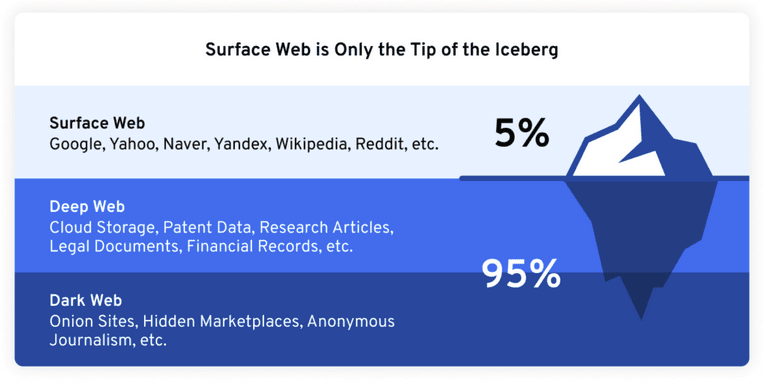
The Deep Web got the name hidden or invisible web. Why? We can picture it as the part of web pages, documents or information that search engines do not index and which is therefore "invisible" to ordinary internet visitors. Most experts estimate that the Deep Web is far larger than the ordinary web. Many websites are generated dynamically or have no links from other pages.
You can reach Deep Web sites by entering a particular URL or IP address, but you often have to enter a password or other security details to reach the actual content.
Users use these sites for various purposes such as managing webmail, doing online banking, accessing cloud storage, visiting social media pages with restricted access, taking part in web forums that require registration, and using paid services such as video streaming on demand and reading selected online magazines and newspapers.
Real cases of the Deep Web
The Deep Web holds a huge amount of information and data meant for specific purposes and for particular users. Let us look together at everything the Deep Web contains.
Medical records: personal health information including medical records, diagnostic reports and patient histories is often stored on the Deep Web for reasons of privacy and security.
Financial information: online banking, which is available only to authorised users.
Company intranets: organisations' internal networks containing sensitive company information accessible only to employees.
Membership websites: platforms requiring paid or exclusive membership, such as sites with premium content. These may be professional organisations, specialised communities or specialised interest groups.
Paid content: the deep web includes an extensive store of paid content including digital courses, e-books, research papers, films and more. Access to these resources requires paid access.
Paywalled publications: many respected online newspapers and magazines use subscriber-only access to content.
Scientific and research journals: a significant part of academic research and professional articles is on the Deep Web and is accessible through subscriptions or educational institutions' academic databases.
Deep Web vs Dark Web
The Deep Web is legal and contains a large part of the everyday internet used by individuals and organisations for various purposes. The Dark Web, on the other hand, is a subset of the Deep Web that is deliberately hidden and accessible only using special tools such as the Tor anonymising network. The Dark Web is often associated with illegal activity such as trading in drugs, weapons or stolen information. More in our article.
The main differences lie in:
Visibility: the Deep Web is essentially the part of the web search engines do not index, such as your online banking or email.
Content: the Deep Web consists of legal, ordinary sites, whereas the Dark Web is often associated with illegal activity.
Anonymity: the Deep Web and the Dark Web alike offer a degree of anonymity. The Deep Web's anonymity is a by-product of security measures protecting privacy.
Legality: while the Deep Web is legal, plenty of unlawful activity takes place on the Dark Web. Taking part in unlawful activity on the Dark Web can have serious consequences.
Access: access to the Deep Web is relatively simple; you are probably already using it daily without realising. The Dark Web requires a specialised type of browser, which makes it less accessible to the ordinary internet user.
A monthly dose of inspiration from Invelity
Every month we deliver fresh news from the world of online marketing straight to your inbox, practical tips from our experienced specialists, an overview of events where we can meet in person, and much more useful information.
10 steps to protecting your privacy on the Deep Web
Now that we are talking about the Deep Web, we have to bear the golden rules in mind: privacy and security online. It is like locking the doors to your house so that your things are safe - only this time it is your digital things.
Use a secure browser
Start using a privacy-focused browser such as the Tor browser, which hides your IP address and gives a more anonymous presence online.
Mask your identity
When creating accounts or signing in to websites, use pseudonyms and avoid sharing personal details.
Secure your connection
Do not use sites that do not have an active HTTPS certificate. Using a virtual private network (VPN) can add another level of security and make eavesdropping harder.
Avoid oversharing
Just as you do not give your address to a stranger, be careful about sharing personal details in private messages or profiles on deep web platforms too.
Watch out for scams
Watch out for phishing scams where fraudsters pose as trustworthy entities to steal your data. Verify websites' and emails' authenticity before interacting with them.
Keep your software updated
Update your browser, security software and operating system regularly to patch vulnerabilities hackers could exploit.
Watch out for clickbait
As in the real world, online too people try to lure you with sensational headlines. Be careful when something seems too good or too shocking to be true.
Avoid unknown links
Avoid clicking random or unsolicited links. Stick to trustworthy websites and sources and do not stray into unknown territory.
Avoid downloading suspicious files
If you come across something you want to download, make sure it is from a trustworthy source. Downloading random files can bring malware into your device.
Use ad blockers
Some ads can lead to dubious places. With blockers you can reduce the likelihood of reaching dubious websites through an advertisement.
The Deep Web contains a huge amount of useful, important information that ordinary search engines do not see. It covers everything from academic databases and health records to financial information and company intranets. While the Deep Web is not dangerous, it matters to be aware of the difference between it and the Dark Web and to approach it with due caution and respect for privacy. So be exceptionally careful when browsing the Deep Web.
Recommended reading
The latest trends, proven practices and analyses from the digital world. Find out how to take your technology and marketing growth further.